What if the next generation of supercomputers did not merely render faster, but operated in a completely different way? That’s the direction IBM is headed in with four new partnerships at U.S. National Quantum Information Science Research Centers around the country. The partnerships, unveiled on 4 November 2025, are designed to fast-track quantum-inspired supercomputing, the hybrid architecture combining classical and quantum methodologies.
The announcement comes on the heels of the U.S. Department of Energy’s additional funding for the NQISRCs, which were first funded under 2018’s National Quantum Initiative Act, a law that provided up to US$625 million to create these centers. In 2016, IBM began partnering with four of the five, positioning itself squarely in the center of the country’s quantum-research landscape.
Constructing a new type of supercomputer
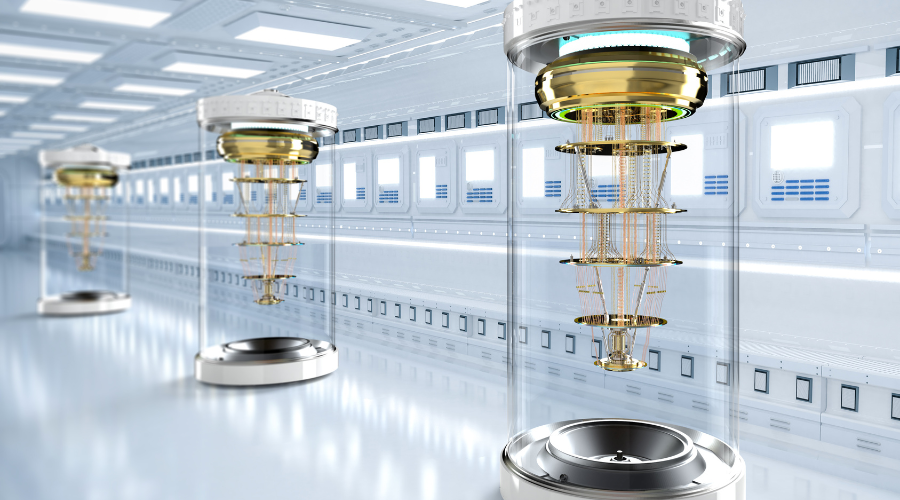
QCSC (quantum-centric supercomputing) is IBM's vision for the future, which entwines CPUs, GPUs, and QPUs forming one tightly packed system. For IBM, the real triumph will come when quantum communication and sensing capabilities are directly integrated into this structure.
IBM is pursuing two key approaches to get there: scaling up quantum constituents toward a quantum-computing internet and building so-called quantum-ready algorithms that can run on hybrid systems. The two are critical building blocks toward a future in which quantum machines are operated as networked components of an even more powerful system.
Connecting quantum systems across distances
Among the more ambitious of IBM's initiatives is an intended partnership with Fermi National Accelerator Laboratory’s Superconducting Quantum Materials and Systems Center (SQMS). The project's goal is to connect two IBM quantum computers, each housed in cryogenic units, with microwave-based quantum networking devices. If all goes well, the machines could share entangled states across a multi-meter network, a day that IBM aims to reach within five years.
Additionally, IBM is working on a second networking project with the Q-NEXT program at the Argonne National Laboratory that focuses on optical-based quantum links that go from meters to kilometers. To achieve this, IBM will need to make significant progress in the "microwave-to-optical transducer technology" sector.
Developing real-world quantum applications
In addition to networked endeavors, IBM is working with the Quantum Science Center (QSC) at Oak Ridge National Laboratory on other algorithmic frontiers. This involves pinpointing scientific workloads that quantum methods might be able to surpass brute-force classical computation.
The company is also collaborating with the Co-design Center for Quantum Advantage (C2QA) at Brookhaven National Laboratory, using quantum computers to solve complex problems and queries such as those found in high-energy physics and condensed-matter simulations. This research reflects a switch from hardware-centred development to full-stack workflows that integrate classical, quantum, and error-mitigation technique.
Building the Quantum Internet of the Future
IBM is evolving from isolated experiments to a systemic strategy. As these classical and quantum systems coexist, it is easy to see how QCSC hardware could revolutionise scientific simulation, optimisation problems, materials science, or cryptography. The message for the vendor and partner ecosystem is clear: "A pathway to practical application of quantum computing exists."
Systems integrators and enterprise IT architects will have to understand how quantum modules, hybrid workflows, and quantum networking might fit into future HPC ecosystems. IBM is inviting research institutions, systems and software integrators, and enterprise organizations to apply for the quantum ecosystem program. Those who are interested can participate via IBM’s quantum resources, partner programmes or by consulting with IBM’s channel teams.
A new dimension
For IBM, working with four national quantum centers reflects a move toward computing systems that integrate classical and quantum performance. As researchers push the boundaries of traditional HPC systems and with quantum-fueled infrastructure on the horizon, we are closer than ever to a new dimension in computing.