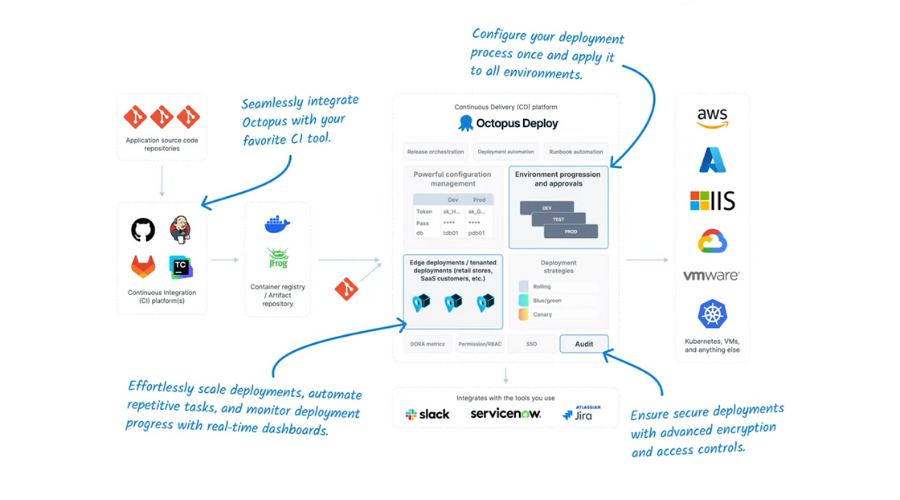
When Octopus Deploy first emerged, it was known primarily for automating the last mile of CI/CD, bridging the gap between continuous integration and reliable, repeatable deployments. It helped businesses deliver software to Kubernetes, multi-cloud, on-prem infrastructure, and anywhere else. Fast-forward to today, and the conversation has evolved far beyond automation alone.
Octopus has become a critical enabler for platform engineering, helping organizations codify their security and operational policies into reusable, automated workflows that promote healthier, more consistent platform adoption. In an era where cloud-native complexity often overwhelms teams, Octopus provides a framework to turn security, compliance, and reliability principles into embedded, living parts of your delivery pipeline.
This blog post is based on a webinar by SoftwarePlaza with Steve Fenton, Head of DevRel and Principal DevX Researcher at Octopus.
1. The evolving role of Octopus in the platform engineering era
A couple of years ago, Octopus was known for its deployment automation. Today, it’s a platform enabler, providing structure and reliability to organizations scaling DevOps, GitOps, and internal development platforms (IDPs).
While the core philosophy of the brand has remained consistent with making software delivery reliable, repeatable, and auditable, the context has changed. Modern DevOps teams are managing ever-growing microservices, hybrid infrastructure, and compliance-heavy workloads.
As a result, the need now is not just automation, it’s a system of governed automation guided by operational and security policies.
Octopus is extending its governance into the Kubernetes environment by integrating with modern GitOps tools like Argo CD (through its Codefresh acquisition). This ensures that every deployment adheres to version-controlled configurations and organizational policies.
The result: a healthier balance between speed and security.
2. Policy-driven automation: making policy mandatory, not the platform
The founders of Octopus believe in a simple statement - make your policies mandatory, not your platform.
By adopting this practice, organizations can prioritise compliance and security policies over forcing developers to use a platform, while using platform such as Octopus to handle the enforcement automatically.
When developers are required to meet specific security standards (such as generating SBOMs,
conducting SAST/DAST scans, or following change approval workflows), they choose to use the platform that makes it easiest to stay compliant. Octopus transforms these policies into pipelines-as-code, automatically applying them at every stage: build, test, deploy, and operate.
This approach aligns autonomy with accountability. Developers retain flexibility, while the organization ensures consistent adherence to policies without relying on manual enforcement.
The result is a healthier adoption curve, where compliance becomes an effortless part of daily workflows.
3. GitOps and the expansion of secure deployment practices
In the past, Octopus focused on “last-mile” automation. However, with the recent integration with GitOps principles, it now supports continuous reconciliation and policy-based configuration management.
Many companies adopt a “partial GitOps” approach, where they store configurations in Git but fail to reconcile the running state with the desired state continuously. This creates drift and operational risk. Octopus helps close that gap by synchronizing version control with actual deployment states, ensuring immutable, auditable pipelines that are always in compliance.
Through Codefresh and Argo CD, Octopus now supports declarative deployments at scale. Each configuration change becomes a version-controlled policy artifact, providing visibility, traceability, and rollback capability across clusters and environments.
This strengthens both security posture and operational hygiene, as any unauthorized drift or manual configuration is instantly flagged and corrected.
4. Reducing complexity: from fragmentation to unified policy implementation
A significant challenge in platform engineering is that complexity often shifts rather than disappears. Many organizations move deployment pain from development teams to the platform team, without addressing root causes.
Octopus solves this by encoding standardized operational decisions, such as how to deploy containers, manage secrets, or perform health checks, into reusable templates and runbooks. This converts tribal knowledge and ad-hoc scripts into governed, reusable blueprints that enforce best practices across environments.
By defining these policies once and applying them everywhere, organizations eliminate configuration drift and reduce dependency on individual expertise. Teams no longer waste hours debating YAML patterns or tool choices; Octopus abstracts that into secure defaults aligned with company policy.
5. Enforcing security and compliance through the delivery pipeline
Security compliance has become a key differentiator for mature platform engineering teams. Octopus embeds policy enforcement throughout the CI/CD lifecycle, including pre-deployment, where it validates code, configurations, and dependencies using integrated scanning tools (SAST, DAST, SBOM), during deployment by enforcing least privilege access, auditing every action, and maintaining a complete change history, and during post-deployment by integrating monitoring and observability to detect drift or policy violations.
These workflows ensure that every deployment is secure by default and compliant by design, whether it’s a production rollout, a hotfix, or an infrastructure change.
The key here is automation. Rather than treating compliance as an afterthought, Octopus weaves it into every deployment cycle, helping teams demonstrate continuous audit readiness.
6. Feedback loops and metrics: measuring healthy adoption
Research shows that feedback frequency is directly linked to platform success. Organizations that focus on getting feedback from developers monthly or more often are significantly more likely to achieve their platform goals.
Octopus enables these loops by providing visibility and collaboration features, which allow developers to offer contextual feedback, identify friction points, and suggest optimizations.
On the other hand, metrics also play a vital role. The Platform Engineering Pulse Report highlights that successful platform teams measure diverse metrics, from deployment frequency and build time to policy compliance rates and incident recovery times.
Interestingly, teams that track multiple metrics (five or more) tend to have healthier adoption than those monitoring only one or two. Octopus supports these insights through its analytics and reporting dashboards, helping teams visualize where policies improve speed, reliability, and security.
7. Applying DORA and MONK metrics to platform health
Octopus encourages teams to use DORA metrics, lead time, deployment frequency, change failure rate, and mean time to recovery to evaluate both developer and platform team performance.
However, MONK metrics (Market share, Onboarding time, NPS, and Key outcomes) provide a complementary lens for platform engineering. Octopus’s reporting tools help quantify:
- Adoption rate (Market share) – How many teams are actively using the platform
- Onboarding time – How quickly teams can deploy using standardized templates
- NPS/CSAT – Developer satisfaction with platform usability
- Key outcomes – How the platform improves cost efficiency, compliance, or delivery performance
By tracking these metrics, Octopus users can demonstrate tangible ROI, essential for securing ongoing investment in platform initiatives.
8. Creating sustainable platforms: collaboration over control
The most successful platform teams don’t enforce compliance through control but through collaboration and shared ownership. Octopus offers “inner sourcing,” where developers can contribute improvements back to the platform, such as optimizing build caches, improving templates, or adding observability features.
This method creates a flywheel of continuous improvement, where the platform evolves organically through real-world contributions. As a result, developers feel empowered, leading to genuine enthusiasm for platform adoption.
Conclusion: Toward Healthier, Policy-Driven Platform Adoption
The evolution of Octopus mirrors the broader shift in DevOps: from automation to intelligent governance. Octopus has been instrumental in transforming policy compliance from a checkbox into a competitive advantage, creating a healthier ecosystem where developers thrive, operations stay compliant, and the business moves faster with confidence.
This blog is based on a webinar with Steve Fenton. You can watch the full video here.